
How Sake Is Made: A Complete Guide to Sake Production

Quick answer: Sake is made in roughly eight stages, polish the rice, wash and steam it, grow koji mold on part of it, build a yeast starter (moto), ferment the main mash (moromi) over about 24-35 days while starch and sugar convert simultaneously, then press, filter, pasteurize, and age it. Most finished sake lands around 15-16% ABV.
On this page
Key Takeaways
- Sake is brewed, not distilled, it's closer to beer than to wine, but its process is unique.
- Its defining feature is multiple parallel fermentation: saccharification (starch → sugar) by koji and fermentation (sugar → alcohol) by yeast happen at the same time, in the same vessel.
- The core stages are polishing, washing and steaming, koji-making, the moto starter, the moromi main mash (added in three stages), pressing, filtration, and pasteurization.
- Only four ingredients are needed: rice, water, koji (Aspergillus oryzae), and yeast.
- Most finished sake is around 15-16% ABV; undiluted genshu can be higher.
- Colorado Sake Co. has brewed fresh, small-batch sake in Denver's RiNo Art District since 2018.
What Makes Sake Different from Beer and Wine
Sake is often called "Japanese rice wine," but in how it's actually made, it's far closer to beer, both start with a grain whose starch has to be converted into sugar before fermentation. The crucial difference is when that conversion happens.
Wine is the simplest: grapes already contain sugar, so yeast can ferment the juice directly. Beer is a two-step process, brewers first convert barley starch to sugar (mashing), then ferment that sugar in a separate stage. Sake collapses those two steps into one. The koji mold keeps breaking rice starch into sugar at the same time the yeast is converting sugar into alcohol, side by side in a single tank. Brewers call this multiple parallel fermentation (heikō fukuhakkō), and it's the defining process behind sake, a technique you won't find in winemaking or standard brewing. It's also why sake can reach a relatively high alcohol level, often around 18-20% in the tank before dilution, without distillation.
How sake differs from wine and beer
| Drink | Sugar source | Key fermentation step |
|---|---|---|
| Wine | Grape sugar (already present in the juice) | Single fermentation, yeast ferments existing sugar directly. |
| Beer | Malted-grain starch converted to sugar | Sequential, starch is mashed to sugar first, then fermented in a separate stage. |
| Sake | Rice starch, converted to sugar by koji | Multiple parallel fermentation, koji turns starch to sugar while yeast ferments that sugar to alcohol, simultaneously in one tank. |
If you're still getting your bearings on the drink itself, our complete guide to what sake is is a good companion to this production walkthrough.
The Four Ingredients of Sake
Premium sake is made from just a few core ingredients, rice, water, koji, and yeast, though some non-Junmai styles also add a touch of distilled brewer's alcohol. Their quality, far more than their quantity, shapes the final pour.
Sake Rice (Sakamai)
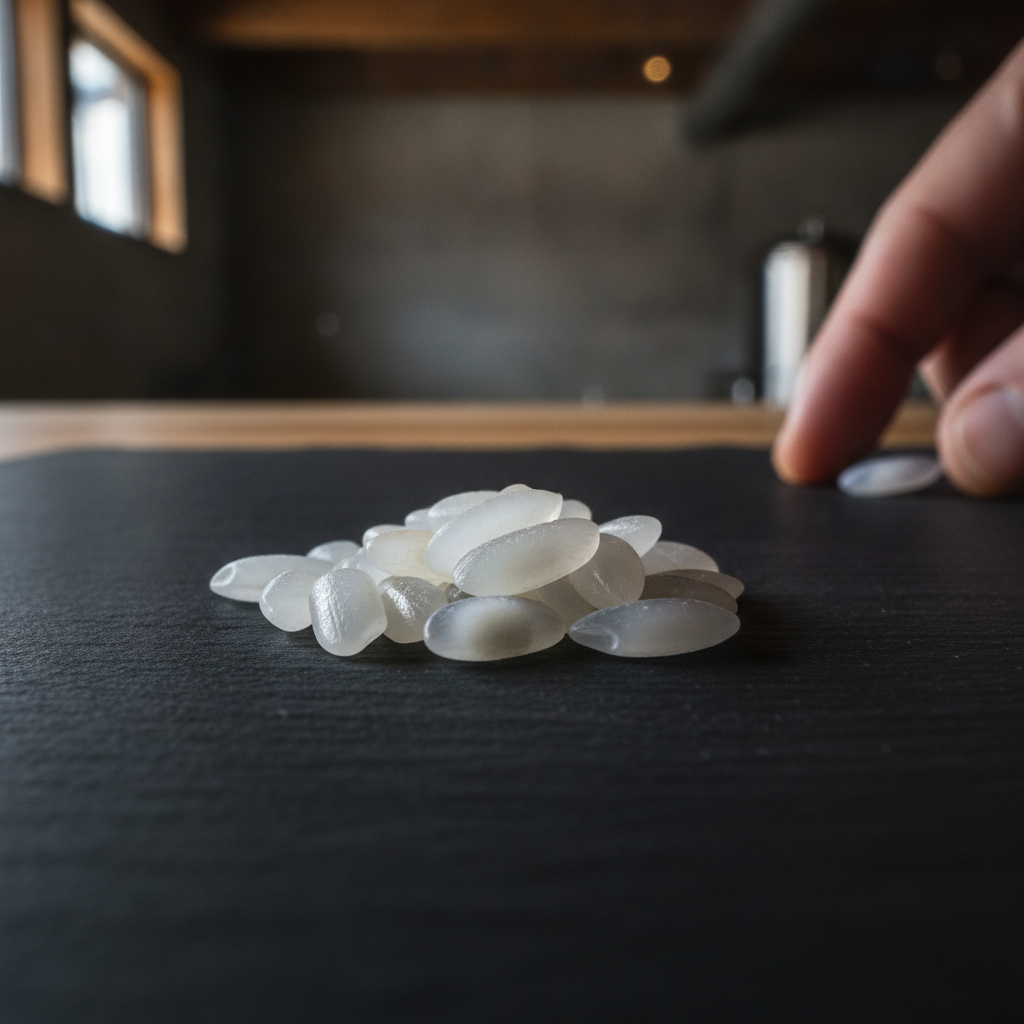
Sake begins with specialized rice varieties called sakamai, which differ from table rice in important ways. The grains are larger and carry a concentrated, opaque core of starch called the shinpaku, with lower protein and fat toward the outside, qualities that lead to cleaner fermentation and clearer flavor. Classic Japanese strains include Yamada Nishiki, Gohyakumangoku, and Omachi. American brewers have shown that thoughtfully chosen domestic rice can make excellent sake too; we explore that frontier in our guide to brewing with American-grown rice.
Water
Water makes up roughly 80% of finished sake, so its mineral profile matters enormously. Soft water tends to yield elegant, refined sake, while harder, mineral-rich water can drive a more robust, full-bodied style and a faster ferment. Historically, Japanese breweries were sited near prized water sources; today, filtration lets a brewer tune water chemistry to a chosen style almost anywhere.
Koji (Aspergillus oryzae)
Koji is the heart of sake. It's a cultivated mold, Aspergillus oryzae, grown on steamed rice, and it produces the enzymes that convert rice starch into fermentable sugar. Without koji there is no sake, and because it keeps producing sugar throughout fermentation, it's also what enables multiple parallel fermentation. Beyond sugar, koji contributes umami and subtle aromatics.
Yeast (Kobo)
Yeast turns sugar into alcohol and carbon dioxide, and the strain chosen shapes much of the aroma and character, from fruity, floral notes to clean, restrained profiles. Different strains tolerate different temperatures, giving brewers another lever for control. Many breweries guard proprietary yeast cultures that help define their house style.
How Sake Is Made: The Full Process
Here is the process stage by stage, in the order a brewer works through it. The whole sequence usually takes about six to eight weeks, and some premium batches take longer.
Step 1-2: Polishing, Washing, and Steaming the Rice
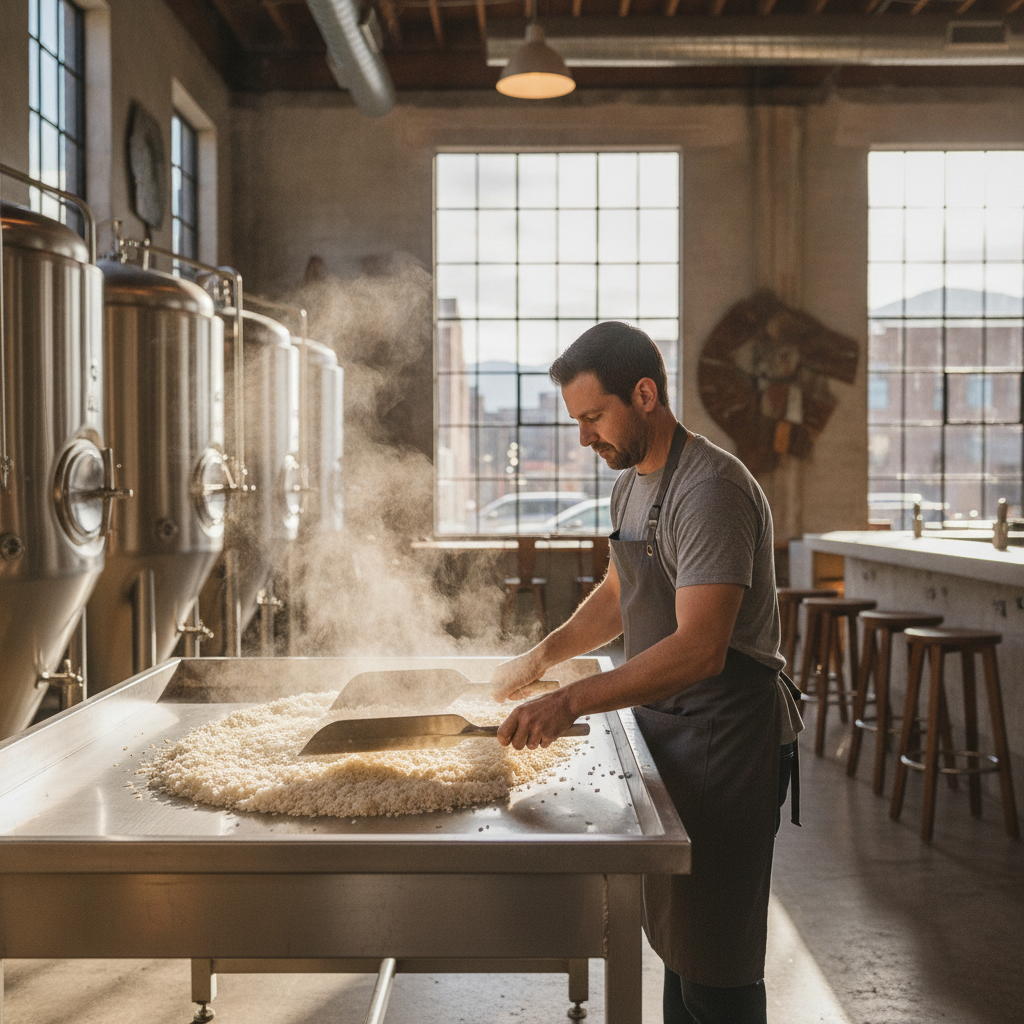
First the rice is milled, or polished, to grind away the outer layers, rich in protein and fat, and expose the starchy shinpaku core. How much is removed is measured by the seimaibuai (the percentage of grain that remains). More polishing generally means a cleaner, more refined, more aromatic sake, and it's tied to legal grade classifications. Because seimaibuai measures the percentage of grain that remains, a grade that requires "at least X% removed" is the same as "X% or less remaining." Under the legal definitions set out by the Japan Sake and Shochu Makers Association, Daiginjo uses rice polished so at least 50% is removed (50% or less remaining), Ginjo at least 40% removed (60% or less remaining), and Honjozo at least 30% removed (70% or less remaining). Milling alone isn't enough for the top grades, though: Ginjo and Daiginjo also require the specialized low-temperature ginjo-zukuri brewing method, a slow, cool ferment that develops their delicate aromatics. The polished rice is then carefully washed and soaked, timing measured to the second for premium batches, because how much water the grain absorbs affects everything downstream, and finally steamed rather than boiled, which firms the outside while keeping the inside workable.
Step 3: Making Koji (Seigiku)
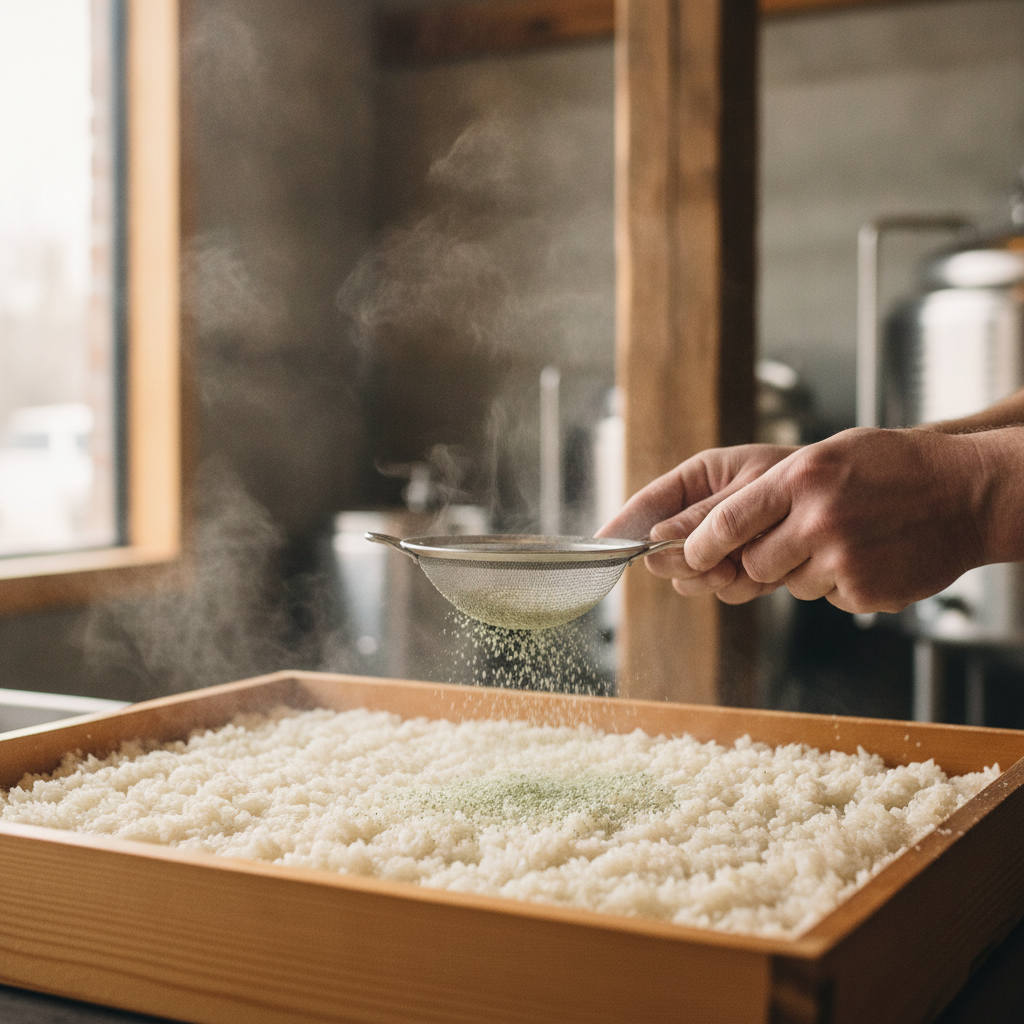
A portion of the steamed rice is cooled and moved to a warm, humid koji room (kojimuro), where the brewer dusts it with koji-kin spores. Over roughly 36 to 48 hours, the mold spreads through the grain while the brewer repeatedly mixes it and adjusts temperature and humidity. This is the most hands-on, watchful stage of the whole process, in our RiNo brewhouse it means checking on the koji at all hours, because the enzymes it builds here will drive sugar production for the entire ferment.
Step 4: The Moto / Shubo (Yeast Starter)
Next the brewer builds a concentrated yeast starter called the moto (or shubo, literally "mother of sake"), combining koji rice, steamed rice, water, and a chosen yeast. The goal is to cultivate a dense, healthy population of yeast in an acidic environment that holds off unwanted microbes. Traditional methods can take a few weeks; faster modern methods add lactic acid directly to shorten that window. The moto is small, but it sets the trajectory for the whole batch.
Step 5: Moromi (The Main Mash) and Multiple Parallel Fermentation
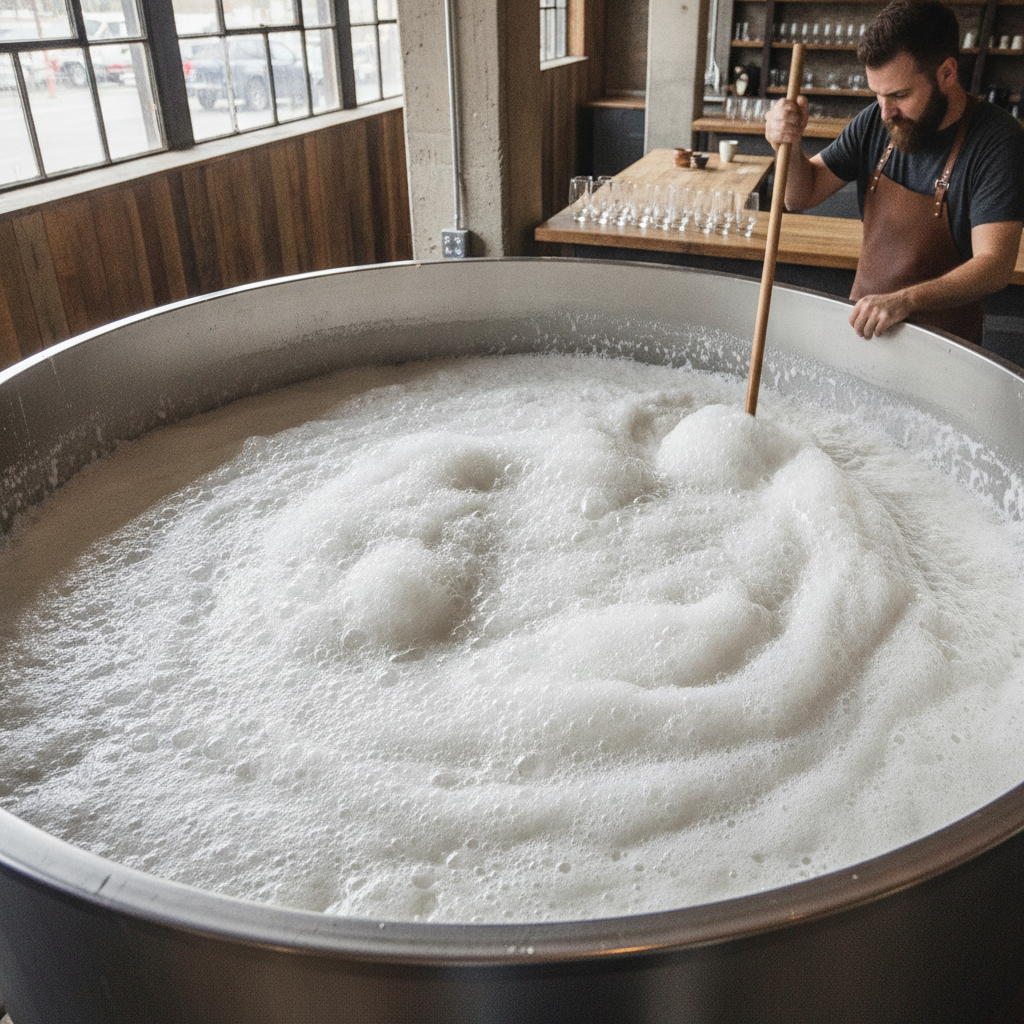
The moto is moved to a larger tank to become the moromi, the main fermenting mash, and this is where sake's signature chemistry plays out. Rather than dumping in all the rice, water, and koji at once (which would overwhelm the yeast), the brewer builds the mash in three additions over about four days, a method called sandan-jikomi (three-stage addition). Each addition roughly doubles the batch and keeps the yeast healthy and dominant. From there the moromi ferments for about 18 to 32 days, kept cool. Throughout, koji keeps converting starch into sugar while yeast simultaneously converts that sugar into alcohol, the multiple parallel fermentation that defines sake, gradually pushing alcohol up toward 18-20% before any dilution.
Step 6: Pressing (Joso)
When fermentation reaches the target, the mash is separated into clear sake and the leftover rice solids, called sake kasu (lees). This pressing step is joso. It can be done by machine press, by hanging the mash in cloth bags to let sake drip out under its own weight (a gentle, prized method), or by other traditional means. Sake collected by gravity alone, without pressure from a press, is sometimes labeled accordingly, and cloudy nigori sake is made by pressing through a coarser mesh so fine rice solids remain in the bottle.
Step 7: Filtration and Adjustment
After pressing, most sake is filtered, often with activated charcoal, to refine color and clarity and to smooth the flavor. Many sakes are then diluted with water to bring the alcohol from that high tank strength down to a drinkable 15-16% ABV. Sake bottled without this dilution is called genshu and runs stronger. In the U.S., how a finished sake is produced and labeled, including its stated alcohol content, falls under the Alcohol and Tobacco Tax and Trade Bureau (TTB).
Step 8: Pasteurization (Hi-ire) and Aging
Most sake is pasteurized, a step called hi-ire, by gently heating it, usually twice, to stabilize it and halt any further enzyme or microbial activity. Sake that skips this is namazake ("raw" sake), which is lively and fresh but must be kept cold and is the style we love serving straight from the tank. Finally, many sakes are aged for several months to let the flavors settle and harmonize before bottling, though some are released young to capture their fresh character.
The Sake-Making Process at a Glance
| Stage | What happens | Why it matters |
|---|---|---|
| 1. Polishing (seimai) | Rice is milled to remove outer layers and reach the starchy shinpaku core. | Cleaner flavor; sets the sake's grade (seimaibuai). |
| 2. Washing & steaming | Polished rice is washed, soaked to a precise water content, and steamed. | Prepares starch to be accessible to koji and yeast. |
| 3. Koji-making (seigiku) | Aspergillus oryzae is grown on part of the steamed rice over ~36-48 hours. | Creates the enzymes that turn starch into sugar. |
| 4. Moto / shubo starter | A small, acidic yeast starter is cultivated from koji, rice, water, and yeast. | Builds a strong, healthy yeast population to lead the batch. |
| 5. Moromi main mash | Rice, koji, and water are added in three stages (sandan-jikomi); ferments ~18-32 days. | Multiple parallel fermentation, starch → sugar → alcohol, all at once. |
| 6. Pressing (joso) | Mash is separated into clear sake and rice lees (kasu). | Yields the liquid sake; method affects clarity and texture. |
| 7. Filtration & dilution | Sake is filtered and usually diluted to drinking strength. | Refines clarity and flavor; sets final ABV (~15-16%). |
| 8. Pasteurization (hi-ire) & aging | Most sake is gently heated and then aged before bottling. | Stabilizes the sake and lets flavors harmonize. |
Modern and American Craft Methods
The fundamentals above are centuries old, but modern brewing layers technology on top of tradition. Temperature-controlled tanks, automated polishing mills, refined filtration, and precise measurement let brewers hold conditions steady that earlier generations could only coax by hand. None of it replaces the craft, it makes consistency more achievable.
American craft sake, including ours, takes the same core process and adapts it to local conditions and tastes. Like many U.S. breweries we experiment with domestic rice and new flavor directions while keeping the koji-driven, multiple-parallel-fermentation backbone intact. According to the Japan Sake and Shochu Makers Association, these core steps, koji, starter, and the three-stage mash, are the backbone of nearly every sake, in Japan and beyond.
Brewing sake a mile high
Denver sits about a mile above sea level, and that elevation isn't just scenery, it subtly affects the brewing. At lower atmospheric pressure water boils at a lower temperature, so steaming the rice behaves differently than it does at sea level in Japan: the steam runs cooler, and getting the grain to the right firm-outside, workable-inside texture takes adjustment rather than a copied-over time chart. The thinner, drier air also drives faster evaporation, which nudges how we manage moisture during koji-making and how quickly surfaces and mash give up water. Most of all, the cool, dry climate is something we deliberately tune our process around, the difference between a clean, aromatic ferment and an unruly one. In our RiNo brewhouse we ferment the moromi cold, starting near 6°C (43°F), climbing slowly to a 9.5-10.5°C (49-51°F) peak, then easing it back to about 5°C (41°F) in the days before pressing, a fermentation of roughly 24-35 days. Our brewing water is reverse-osmosis water we make in house, then re-mineralize with salts to match the mineral balance of Miyamizu, the famous brewing water of Japan's Nada region. We start ours by stripping our water back to near-zero with reverse osmosis, then rebuild it with brewing salts. Miyamizu itself is on the soft side, prized not for hardness but for a specific blend of fermentation-friendly minerals. We've leaned into all of this since 2018; you can read more about brewing sake a mile high, and about how we approach brewing with American-grown rice, if you're curious how it plays out in practice.
Curious to taste the result of all this? Visit our RiNo taproom, browse the sake we brew, or order a bottle online.
Frequently Asked Questions
How long does it take to make sake?
What is multiple parallel fermentation?
Is sake brewed or distilled?
Is sake gluten-free?
See how we brew it
Colorado Sake Co. has brewed fresh, small-batch sake in Denver's RiNo Art District since 2018. Visit the taproom or order sake online.
Colorado Sake Co. serves guests 21+. Please enjoy sake responsibly.
Keep exploring
Run into a word you did not know? Our Sake Field Guide is a plain-language glossary of the terms on every bottle, from junmai and ginjo to koji, nigori, genshu, and seimaibuai, written by the brewers who use them.